
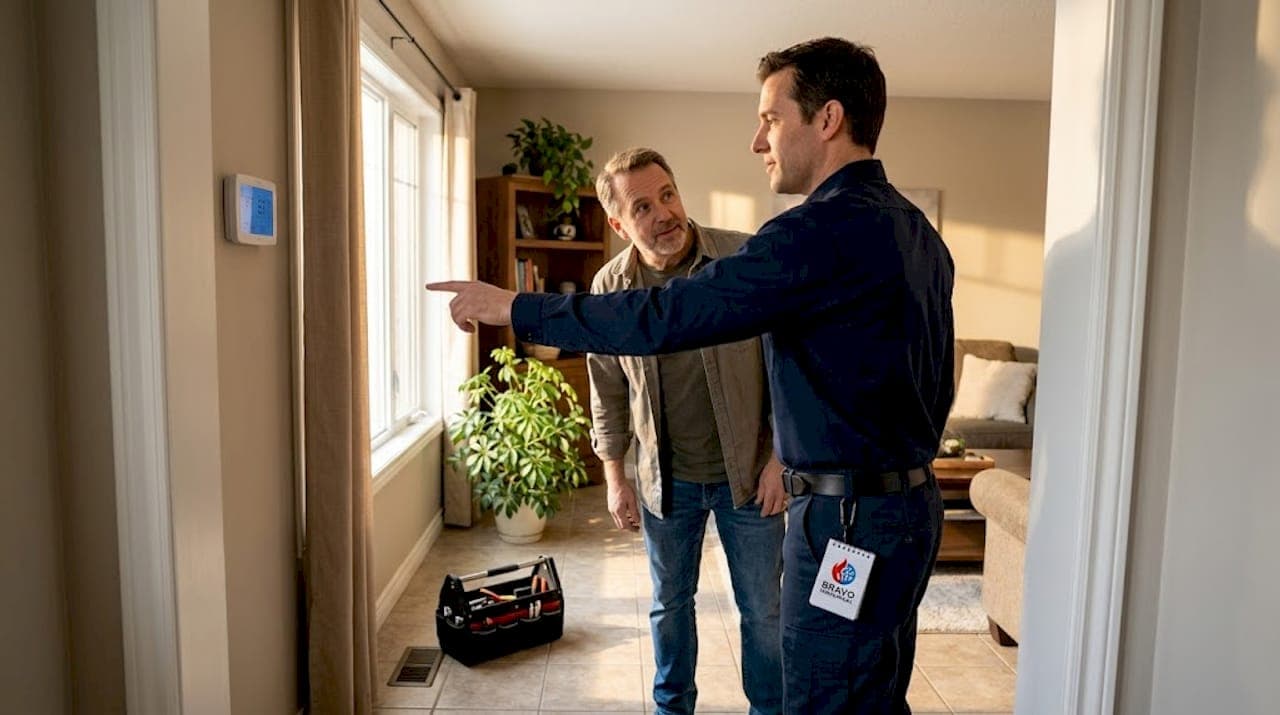
Your HVAC system starts short-cycling, or one room stays stubbornly cold while the rest of the house is fine. You call a technician, they swap a part, and two weeks later the same problem is back. That cycle is expensive and frustrating, and it almost always traces back to one missed step: a proper HVAC diagnostic process. Understanding what that process actually involves helps you ask better questions, avoid unnecessary repair bills, and make sure the root cause gets fixed the first time.
Table of Contents
- Key takeaways
- What is an HVAC diagnostic process: the steps professionals follow
- Common problems found during an HVAC inspection
- How to prepare for a diagnostic visit
- Why preventive maintenance reduces diagnostic problems
- My honest take on HVAC diagnostics
- Get a thorough HVAC diagnostic from Bravomechanicalny
- FAQ
Key takeaways
| Point | Details |
|---|---|
| Diagnostics start with conversation | Technicians gather symptom history before touching any equipment to narrow down fault categories faster. |
| Measurement beats guesswork | Healthy AC systems show a 14-20°F temperature split; deviations point directly to airflow or refrigerant problems. |
| Homeowner prep saves money | Checking breakers and thermostat batteries before calling can eliminate unnecessary diagnostic fees. |
| Preventive care extends equipment life | Structured maintenance extends HVAC equipment life by 30-40% and cuts emergency calls significantly. |
| Detailed reports protect you | Always request written diagnostic reports with measured values, not just pass/fail summaries, to protect warranty claims. |
What is an HVAC diagnostic process: the steps professionals follow
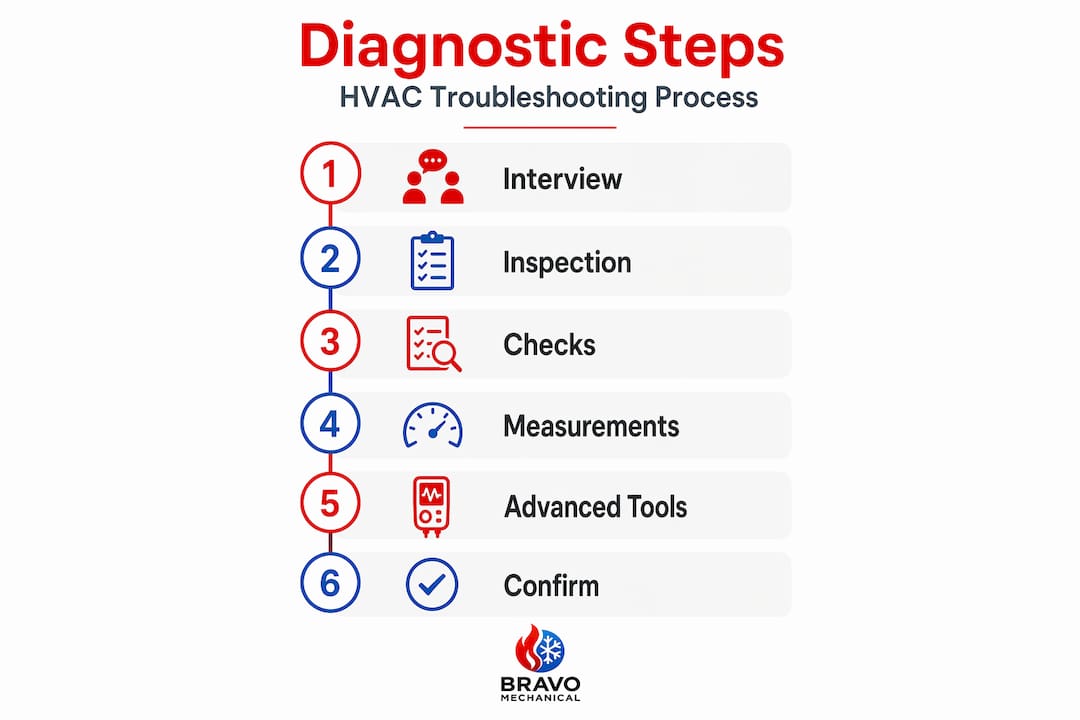
The HVAC diagnostic process is a structured, multi-step method technicians use to identify the root cause of a system problem rather than just treating the symptom. Think of it less like a quick inspection and more like a methodical investigation. Here is how it unfolds.
1. Owner interview and symptom gathering
The diagnostic process begins with a detailed conversation. A good technician asks when the problem started, whether it is constant or intermittent, what sounds or smells accompany it, and whether anything changed recently in the home. This step alone can cut diagnostic time in half by narrowing the fault to a specific system domain before any tools come out.
2. Visual safety inspection
The technician does a walk-around of all accessible components: the outdoor condenser unit, the air handler or furnace, ductwork connections, and the electrical panel. They look for obvious red flags like burnt wiring, ice buildup on refrigerant lines, disconnected ducts, or signs of water damage around the unit.
3. Basic functional checks
Before pulling out instruments, the technician verifies that the thermostat is set correctly, the system is receiving power, and no breakers have tripped. These quick checks prevent spending time on complex diagnostics when the fix is a $5 battery.
4. Instrument-based measurements
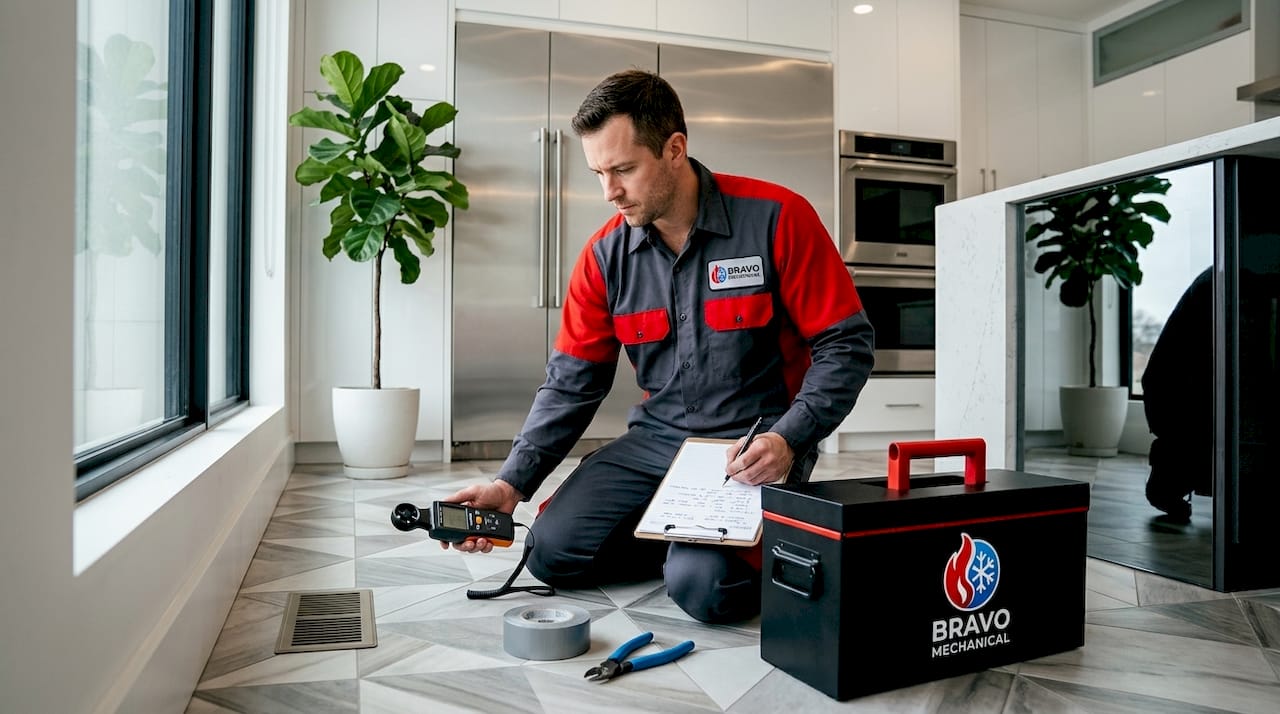
This is where the HVAC system inspection process gets technical. Technicians measure supply and return air temperatures to check the delta T (temperature split). A healthy AC system shows a 14-20°F temperature split between return and supply air. Deviations point to refrigerant charge issues or airflow restrictions. They also measure voltage, amperage draw on motors and compressors, static pressure in the duct system, and refrigerant pressures.
5. Advanced diagnostic tools
For harder-to-find faults, technicians use digital analyzers and thermal imaging cameras. Smart refrigerant gauges calculate superheat and subcooling automatically and log data in real time. Thermal cameras reveal heat loss through duct leaks or failing insulation that would be invisible to the naked eye. Combustion analyzers check furnace efficiency and carbon monoxide levels.
6. Hypothesis, testing, and confirmation
Once measurements point toward a likely cause, the technician tests that hypothesis before ordering parts or making repairs. After the fix, they re-measure to confirm the system is back within spec. Documented findings with actual measured values then go into a written report for the homeowner.
Pro Tip: Ask your technician to show you the before-and-after measurements on paper. A legitimate diagnostic always produces numbers, not just a verbal summary.
Common problems found during an HVAC inspection
Once you understand how to diagnose HVAC issues, it helps to know what technicians actually find most often. These are the faults that show up repeatedly during a thorough HVAC system inspection process.
- Duct leaks. Leaky ductwork can cause up to 30% efficiency loss, meaning your system works harder and costs more while delivering less conditioned air to the rooms you actually use.
- Refrigerant problems. Low refrigerant is almost always a leak, not just a matter of "topping off." Running a system with improper charge stresses the compressor and leads to premature failure.
- Failed capacitors and relays. These small electrical components are among the most common reasons an AC or heat pump stops starting. They are inexpensive to replace but cause expensive secondary damage if ignored.
- Airflow restrictions. Dirty filters, clogged evaporator coils, and blocked return vents reduce airflow dramatically. Reduced airflow causes the system to freeze up or overheat, depending on the season.
- Thermostat wiring errors. Miswired or misconfigured thermostats cause erratic cycling, incorrect temperature readings, and systems that run when they should not.
- Incorrect system sizing. Manual J calculations often reveal that the original equipment was never properly sized for the home, causing short-cycling in oversized units or constant running in undersized ones.
- Combustion issues in heating units. Cracked heat exchangers, dirty burners, and improper gas pressure are safety concerns that only show up when a technician uses a combustion analyzer during the diagnostic.
The takeaway here is that most of these problems share symptoms. Short-cycling, for example, can be caused by refrigerant issues, airflow restrictions, or a bad thermostat. Without a structured diagnostic process, you are guessing.
How to prepare for a diagnostic visit
Getting the most out of an HVAC diagnostic visit is not just the technician's job. How you prepare directly affects how fast and accurately the problem gets identified.
Start by writing down your symptoms before the technician arrives. Note when the problem started, how often it occurs, and whether it is tied to specific outdoor temperatures or times of day. A structured owner interview is one of the most powerful diagnostic tools available, and your observations are the raw material for it.
Before calling, check the basics yourself. Simple checks like breakers and thermostat batteries eliminate unnecessary service charges for problems you could have resolved in five minutes. Also check that your air filter is not completely clogged, since a choked filter is one of the most common causes of reduced performance.
A few more things worth knowing:
- Protect your warranty. Keep records of every professional maintenance visit. Many manufacturer warranties require documented professional service to remain valid.
- Do not touch refrigerants. EPA 608 regulations require certified technicians with specialized equipment to handle refrigerants. DIY attempts are illegal and dangerous.
- Ask for measured values. Request a written report with actual numbers, not just a checklist. Recording precise values during each visit is what allows technicians to detect gradual performance decline over time.
- Communicate openly. If you recently had other work done on your home, like new windows, added insulation, or a renovation, tell the technician. Changes to the building envelope affect HVAC load and can cause problems that look like equipment failures.
Pro Tip: Take a photo of your current air filter before the technician arrives. It gives them instant context about airflow conditions without having to dig through the system first.
Why preventive maintenance reduces diagnostic problems
Preventive maintenance and diagnostics are not separate activities. They are two sides of the same coin. Regular inspections catch developing problems before they become failures, and they generate the measurement history that makes future diagnostics faster and more accurate.
The numbers make a strong case. Structured preventive maintenance reduces emergency HVAC service calls by up to 65% and extends equipment life by 30-40%. For a system that costs $8,000-$15,000 to replace, that extension is worth thousands of dollars.
| Maintenance action | Benefit | Impact |
|---|---|---|
| Annual refrigerant check | Prevents compressor damage | Extends compressor life significantly |
| Duct sealing | Recovers lost efficiency | Up to 30% efficiency improvement |
| Filter replacement (every 1-3 months) | Maintains airflow and coil cleanliness | Prevents freeze-ups and overheating |
| Electrical component inspection | Catches failing capacitors early | Avoids secondary motor damage |
| Combustion analysis (heating season) | Confirms safe and efficient operation | Reduces fuel costs and safety risk |
The real value of condition monitoring over time is that it shifts maintenance from reactive to predictive. When a technician can compare this year's amperage readings against last year's on the same compressor, a small upward trend becomes an early warning. That is how you replace a $200 capacitor instead of a $1,500 compressor.
Scheduling preventive HVAC maintenance in Westchester County before the heating and cooling seasons hit is the single most cost-effective thing a homeowner or property manager can do for their system.
My honest take on HVAC diagnostics
I have seen a lot of systems fail not because they wore out, but because they were never right to begin with. The original equipment was sized by rule of thumb instead of a proper Manual J load calculation, and every replacement unit since has been the same wrong size. The homeowner keeps calling for repairs, the system keeps underperforming, and nobody ever asks the foundational question: was this system ever correct for this house?
That is the problem with replacing equipment "like for like" without a real diagnostic evaluation. You are just perpetuating the original mistake with a new machine.
What I have learned is that the most valuable part of any diagnostic visit is the conversation and the documentation, not the tools. A technician who asks good questions and writes down actual numbers is worth more than one who shows up with expensive equipment but hands you a verbal summary and a repair quote. Measurement records are how you catch a system that is slowly degrading before it fails completely. They are also how you protect yourself if a warranty dispute ever comes up.
My advice: treat every diagnostic visit as a data collection exercise, not just a repair call. The more information you and your technician build over time, the fewer surprises you will face.
— Brahyan
Get a thorough HVAC diagnostic from Bravomechanicalny
If your system is underperforming, cycling oddly, or you just want to know what shape it is actually in, Bravomechanicalny provides detailed HVAC diagnostics and repair for homeowners and property managers across Westchester County, NY. Every visit includes instrument-based measurements, a written report with actual values, and honest recommendations without upselling you on parts you do not need. Whether you need a scheduled maintenance inspection before the season changes or you have an urgent problem that needs same-day attention, the team at Bravomechanicalny brings local expertise and a 5.0 Google rating to every job. For urgent breakdowns, emergency HVAC repair is available across the service area. Call or book online to schedule your diagnostic today.
FAQ
What does an HVAC diagnostic process involve?
The HVAC diagnostic process involves a structured series of steps: a symptom interview, visual inspection, basic functional checks, instrument-based measurements of temperature, pressure, and electrical values, and a written report of findings. The goal is to identify the root cause of a problem, not just the symptom.
How long does an HVAC diagnostic take?
Most professional HVAC diagnostics take between one and two hours, depending on system complexity and how quickly the fault is isolated. Systems with multiple symptoms or hard-to-access components may take longer.
Can I diagnose my HVAC system myself?
Homeowners can check basic items like thermostat settings, breaker panels, and air filters. However, refrigerant handling, electrical testing, and combustion analysis require certified technicians with specialized equipment. Attempting refrigerant work without EPA 608 certification is illegal.
Why does my HVAC keep having the same problem after repairs?
Recurring problems usually mean the root cause was never properly identified. Common culprits include incorrect system sizing, undetected duct leaks, or a failed component that damaged a secondary part. A thorough diagnostic with measured values, not just a visual check, is the only way to break that cycle.
How often should I schedule HVAC diagnostics?
Most HVAC professionals recommend a diagnostic inspection at least once a year, ideally before the heating or cooling season begins. Homes with older equipment or a history of problems benefit from twice-yearly visits to catch developing faults early.